When a Political Visit Turns Into a Public Confrontation
Politics in Nigeria has always been emotional, but social media has changed the speed at which political disagreements can become national controversies. An incident that happens on one road in one state can be recorded on a phone, uploaded to the internet and discussed across the country before the people involved have even had the opportunity to explain what happened.
That is what we are seeing with the controversy surrounding Peter Obi’s recent visit to Benue State.
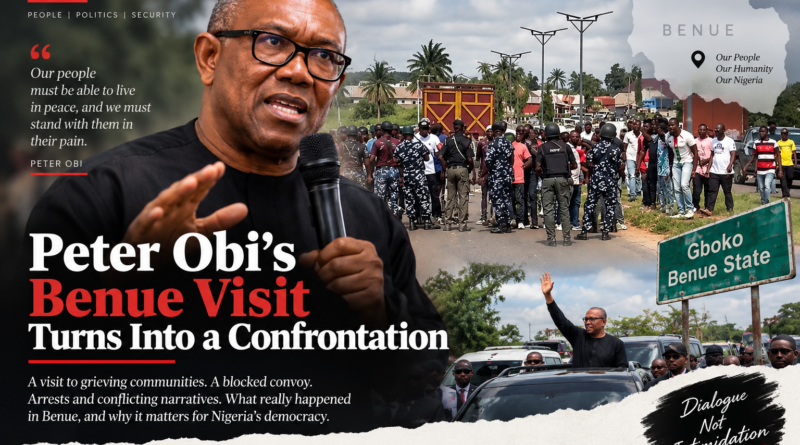
Obi travelled to Benue to visit communities affected by violence and to express sympathy with people who had lost loved ones. During the visit, his convoy was reportedly blocked on Gboko Road by a group of people. Videos of the confrontation quickly circulated online, showing people gathered around the road as Obi and members of his team attempted to continue their journey.
The incident immediately became a political story. Questions about who organised the blockade began circulating almost as quickly as the videos themselves. Obi’s supporters accused people linked to the Benue State Government of being responsible, while the state government denied involvement and said it was not aware of the visit in the manner described by Obi’s camp.
The police subsequently announced the arrest of 46 people in connection with the incident.
At this point, one distinction is particularly important. We can establish that the convoy was obstructed and that arrests were made. What remains disputed is who organised the people involved and whether the incident was politically coordinated. That distinction may seem small, but it is actually at the centre of responsible public discussion.
A Visit That Should Have Been About Condolences
The reason Obi was in Benue is important. The state has experienced devastating attacks, including the killings at Yelwata that shocked Nigerians and drew national attention. Visiting affected communities and offering condolences is something that politicians from different parties can reasonably do, particularly when citizens are facing the consequences of insecurity.
A visit of that nature should ideally provide an opportunity to listen to affected communities and draw attention to their concerns.
Instead, the journey itself became part of the controversy.
This raises uncomfortable questions about the political environment in Nigeria. Has political rivalry become so intense that even a visit to grieving communities can become a source of confrontation?
There is nothing wrong with political disagreement. Democracy depends on competing ideas, parties and visions for the country. However, political competition becomes dangerous when opponents begin to see every action through the lens of hostility.
The Problem With Competing Narratives
One of the difficulties with incidents like this is that Nigerians often receive competing accounts almost immediately.
One side says something happened; the other side says it did not happen that way. Supporters of both sides then present photographs, videos, statements and interpretations that appear to support their preferred version. The public is left to decide who to believe.
Social media makes this even more complicated because people tend to share information that confirms what they already believe. Someone who supports Obi may immediately accept his account because it fits their existing perception of the political environment. Someone who strongly opposes him may dismiss his account before examining the available evidence.
This is how political discussions can become less about discovering the truth and more about defending a political identity. We should resist that tendency.
A political party or politician does not become automatically right simply because we support them. Likewise, a politician does not automatically become wrong simply because we disagree with them.
What Do We Actually Know?
This is where responsible journalism and responsible citizenship become important.
We know that Peter Obi’s convoy encountered an obstruction in Benue, videos of the incident circulated widely, and the police subsequently announced arrests.
We know that Obi’s camp and the Benue State Government have different accounts concerning the circumstances surrounding the incident. What we should not do is take a disputed allegation and repeat it as though it has already been established.
This is particularly important when the allegation concerns political violence or the involvement of a government. Such claims can have serious consequences.
If a government actually organised an attack against a political opponent, that would be extremely serious.
If the government did not do so and the allegation is nevertheless repeated widely as fact, that also creates a serious problem because public trust can be damaged by information that has not been properly established.
The responsible position is to acknowledge what is known, identify what is disputed and allow investigations to establish the rest.
Political Violence Should Concern Everyone
Regardless of political affiliation, Nigerians should be concerned whenever political events become associated with intimidation or violence. We should not become so attached to political personalities that we excuse behaviour simply because it is directed at someone we dislike.
If supporters of one political party attack an opponent, it is wrong. If supporters of another party do the same thing, it is equally wrong. If citizens attempt to prevent a politician from visiting a community peacefully, that should concern us regardless of whether we support the politician.
Democracy requires the freedom to participate in political activity without fear of intimidation. This becomes even more important as Nigeria approaches the 2027 general elections.
The political temperature will continue to rise. Politicians will travel, campaigns will intensify, supporters will become more vocal and social media will amplify almost every disagreement.
We need to be careful about what kind of political environment we create during this period.
Social Media Can Either Clarify or Complicate
The videos from Benue demonstrate the double-edged nature of social media. Without those videos, many Nigerians might never have known that the incident occurred. The footage therefore serves an important purpose because it provides evidence that something happened.
At the same time, a video rarely provides the complete story. It can show what happened in front of the camera without explaining what happened before the recording began. It can show people gathered on a road without telling us who organised them or why they were there.
That is where context becomes essential. Seeing an event is not the same as understanding every aspect of the event.
We Should Be Careful About What We Add to the Story
There is another responsibility that belongs to everyone watching from a distance.
When we share a video, we should be careful about adding information that the video itself does not establish.
If a video shows people blocking a road, we should not automatically say that a particular politician ordered them to do it unless there is evidence supporting that claim.
If a politician says that a government was responsible, we can report that the politician made the allegation without presenting the allegation as an established fact.
This distinction may seem unnecessary in the heat of political debate, but it matters greatly. Once an allegation has been repeated thousands of times, people often forget that it began as an allegation. Eventually, the claim becomes accepted as history.
Nigeria Cannot Afford That
Nigeria already has enough challenges without allowing political disagreements to become another source of instability.
We have insecurity, economic pressure, unemployment, poverty and deep public distrust. Political competition should provide different ideas for addressing these problems rather than creating additional reasons for Nigerians to become hostile towards one another.
Politicians have a responsibility to set the tone; supporters also have a responsibility, the media has a responsibility, and ordinary citizens have a responsibility.
We should demand accountability from politicians without turning every political disagreement into a personal war, defend people against intimidation without inventing facts to strengthen our preferred narrative, and share important information while remaining honest about what we do not yet know.
The Bigger Question
The Peter Obi incident will eventually be replaced by another political controversy, but the underlying issue will remain.
- How do we maintain political disagreement without allowing it to become political hostility?
- How do we hold governments accountable without assuming that every allegation against them is automatically true?
- How do we support politicians without becoming incapable of questioning them?
These questions matter because democracy is not simply about choosing our preferred politician. It is also about protecting the environment in which every citizen can participate.
If a politician can visit a community peacefully, listen to citizens and express condolences without being intimidated, democracy benefits; if a government can be criticised without its supporters or opponents resorting to violence, democracy benefits; or if citizens can examine competing accounts and wait for evidence before deciding what happened, democracy benefits.
That is why the Benue incident should not simply become another political battle between Peter Obi’s supporters and his opponents.
It should cause us to think about the kind of political culture we want Nigeria to have as we move towards 2027.
Political disagreement is inevitable, political competition is necessary, but intimidation, misinformation and violence should never become normal parts of the process.