The Dire Consequences of a Malnourished Mind
We often pay attention to what we eat because we know the body needs adequate nourishment to grow, stay healthy, and function properly. We know the consequences of depriving ourselves of essential nutrients, and we know that food availability does not automatically mean we are eating well. We must choose and consume what our bodies need.
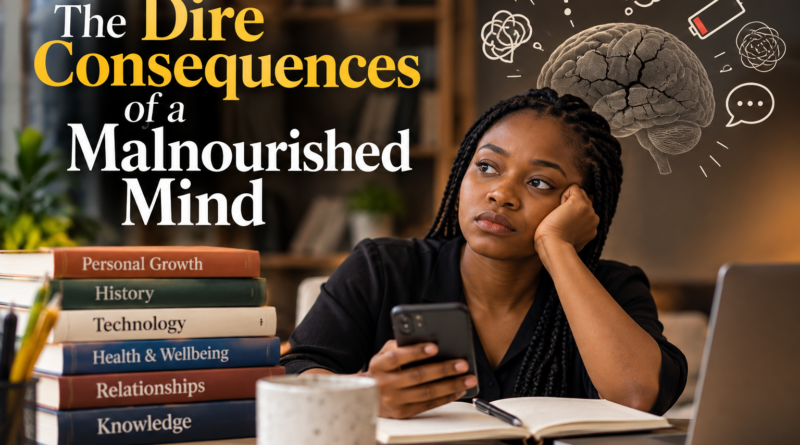
Yet, when it comes to the mind, many people do not exercise the same level of care. They may be surrounded by books, have access to the internet, own smartphones, interact with knowledgeable people and enjoy opportunities to learn, but they make little effort to feed their minds. They have access to knowledge without developing a genuine appetite for it. This is what I would describe as a malnourished mind.
A malnourished mind is not necessarily an unintelligent mind, nor is it always the mind of someone who lacks formal education. It can belong to a university graduate, a successful entrepreneur, a professional or a person who occupies a position of authority. It is a mind that is not being adequately nourished through reading, learning, critical thinking, reflection and exposure to ideas that challenge existing assumptions.
The problem is not always the absence of opportunity. Sometimes, the opportunity is right there, but the willingness to use it is missing.
When Knowledge is available but Ignored
We live in a time when access to information is easier than it has ever been for many people. A smartphone can provide access to books, academic articles, educational videos, lectures, documentaries and conversations with experts from different parts of the world. Public libraries, where available, offer opportunities to explore subjects beyond our immediate experiences. Even a simple question, when approached with genuine curiosity, can become the beginning of a valuable learning experience.
Yet, many people spend hours online without intentionally learning anything new. They scroll through social media, consume gossip, participate in arguments and forward unverified information, while overlooking opportunities to expand their understanding of the world.
There is nothing inherently wrong with entertainment. We all need moments of relaxation, humour and recreation. The concern arises when entertainment becomes the mind’s primary diet, while reading, reflection and meaningful learning are continually postponed.
A person does not have to read several books every month to demonstrate intellectual curiosity. Sometimes, reading one thoughtful article, studying a subject that has always seemed unfamiliar, or listening carefully to someone with a different perspective can make a difference. What matters is the willingness to keep learning rather than becoming comfortable with what we already know.
The Danger of Knowing Too Little but Assuming Too Much
One of the consequences of a poorly nourished mind is the tendency to form strong opinions without making the effort to understand the issues involved. When people do not read widely, ask questions or investigate claims, they may mistake familiarity for knowledge and confidence for competence.
They hear a statement, accept it because it agrees with what they already believe, and repeat it without checking whether it is true. They encounter a different opinion and dismiss it without considering the reasoning behind it. They may even become hostile towards people who challenge their assumptions because they have not developed the patience and intellectual humility that meaningful learning requires.
This is particularly dangerous in a world where misinformation can travel faster than careful explanations. A person who does not cultivate the habit of verification can become an unwitting channel for falsehoods. A person who does not read beyond headlines may misunderstand complex issues, while someone who refuses to learn from other people may continue making avoidable mistakes.
The danger is not simply that such a person may know less than others; it is that they may not recognise the limits of their knowledge.
A Malnourished Mind Can Limit Personal Growth
Learning is not only about acquiring facts. It helps us understand ourselves, relate better with others, make informed decisions and recognise possibilities we might otherwise overlook.
When we stop learning, we risk becoming trapped in familiar patterns of thought. We may continue approaching new problems with outdated assumptions, resist useful changes because we do not understand them, or struggle to adapt when circumstances demand new skills.
Consider the person who refuses to learn about technology despite having access to a smartphone and free educational resources. Over time, that refusal may limit their ability to work efficiently, identify opportunities or protect themselves from digital fraud. Consider the professional who assumes that obtaining a degree means there is nothing more to learn. As their field evolves, their knowledge may gradually become less relevant.
Of course, not everyone has equal access to education, books, reliable internet services or the time required for continuous learning. We must acknowledge these realities rather than assume that every person who reads little is unwilling to learn. Nevertheless, where opportunities exist, a deliberate refusal to use them can become a barrier to growth.
The Cost to Our Relationships and Society
A mind that is not regularly challenged can struggle to appreciate perspectives beyond its immediate environment. When we do not make an effort to understand other people, we may judge them based on stereotypes, misunderstand their experiences or interpret differences as threats.
Reading, meaningful conversations and exposure to different ideas can help us recognise that the world is more complex than our personal experiences suggest. They can teach us to question our first impressions, consider evidence and respond with greater empathy.
These qualities matter in our homes, workplaces, communities and public life. We need people who can think critically, distinguish facts from assumptions, examine public issues responsibly and disagree without becoming abusive. We need leaders who continue learning, parents who remain open to new understanding, professionals who update their knowledge and citizens who take their responsibility to seek the truth seriously.
A society cannot make the best use of its educational resources and intellectual potential when too many people regard learning as something that ends with graduation.
Feed Your Mind Deliberately
The good news is that intellectual nourishment does not require wealth or an impressive collection of books. It begins with curiosity and a willingness to use whatever resources are reasonably available. Read a book or a well-researched article, listen to an educational podcast, ask questions when you don’t understand something, and verify information before sharing it. Have meaningful conversations with people who know things you do not know, and remain willing to reconsider an opinion when the evidence demands it.
Most importantly, do not confuse the ability to access information with the habit of acquiring knowledge. A library card is useful when we read, an internet connection becomes valuable when we use it to learn, and a conversation becomes an opportunity for growth when we listen as well as speak.
We cannot know everything, and nobody should expect us to. What matters is recognising that there will always be more to learn and that our present understanding is never a reason to stop seeking better understanding.
The mind, like the body, needs regular nourishment. When we neglect it, the consequences may not be immediately visible, but they can gradually appear in our decisions, our relationships, our work and our understanding of the world.
The tragedy is not always that knowledge is unavailable. Sometimes, it is that knowledge is within reach, yet we never develop the appetite to pursue it.