Is Knowledge a Privilege? – Why Access to Information Matters
Imagine wanting to learn a new skill, research an important subject or understand a problem affecting your community, only to discover that the information you need is locked behind a payment you cannot afford.
For many people, this is not an imaginary situation. It is a real barrier to learning, research and personal development.
We live in a world where knowledge has the power to transform lives. Access to the right information can help a student understand a difficult subject, a professional develop new skills, a researcher discover new possibilities, and an entrepreneur make better decisions. Yet access to knowledge is not always available to everyone.
Some people have access to well-stocked libraries, extensive digital resources, academic journals and professional databases. Others must rely on limited resources, shared devices, unstable internet connections or whatever information they can obtain without paying.
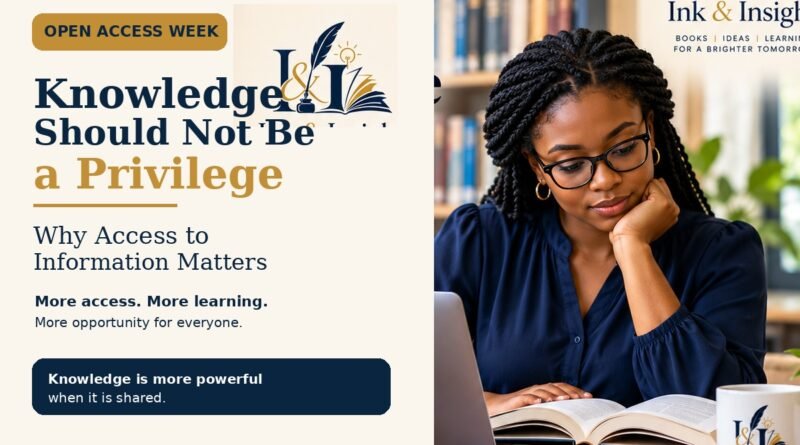
This is why International Open Access Week, observed from 19 to 25 October, is an important opportunity to reflect on how knowledge is created, shared and accessed. Open access supports the free availability of scholarly research and other educational resources, allowing more people to read, learn from and build upon knowledge without unnecessary barriers.
The benefits extend beyond universities and research institutions. When reliable knowledge becomes more accessible, students can learn more independently, educators can discover useful teaching materials, professionals can strengthen their expertise, and communities can make better-informed decisions.
As someone who has been in librarianship and works in knowledge management, I understand that making information available is only part of the responsibility. We must also organise it, preserve it, make it discoverable and help people understand how to use it.
Technology has created new possibilities through digital libraries, institutional repositories, open educational resources and freely available research. However, access still depends on factors such as internet connectivity, digital skills, language, accessibility and the resources available to individuals and institutions.
We must therefore think about access in practical terms. Are students able to find the learning materials they need? Can independent researchers discover relevant studies? Do professionals know where to find reliable resources for continuous learning? Are organisations making appropriate use of the knowledge they already possess?
These questions matter because knowledge becomes more valuable when people can put it to meaningful use.
We can all contribute in small but important ways. We can share credible open educational resources, support libraries, encourage reading, make our own work accessible where possible and help others discover reliable sources of information.
For writers, researchers and content creators, this also means respecting intellectual property and acknowledging original sources. Open access does not mean that the work is free of copyright restrictions. It means supporting appropriate ways for knowledge to be shared and used within clear and responsible conditions.
Ultimately, a person’s opportunity to learn should not be determined solely by their ability to pay for information.
Knowledge is more powerful when it is shared, and society benefits when more people have the opportunity to learn, question, create and contribute.
What do you think we can do to make knowledge and learning resources more accessible in Nigeria and across Africa?