Before You Share That Viral Story, Ask These 5 Questions
Every day, Nigerians wake up to a new viral story.
Sometimes it is a video on WhatsApp, a screenshot making the rounds on Facebook or X, or a voice note claiming that something has happened somewhere. Before long, the story travels from one phone to another, picks up new details along the way, and becomes something everyone seems to know.
But there is a problem.
How much of what we are sharing is actually true?
The question has become even more important this week following reports of a mass abduction in Niger State. A video circulated online appearing to show hundreds of people whom residents identified as victims of the attack. Reuters reported that residents said about 600 people were shown in the footage, but also made it clear that the exact number had not been independently verified.
That distinction may sound small, but it is extremely important.
There is a difference between saying, “600 people were abducted” and saying, “A video appears to show about 600 people who residents say were abducted.”
The first is presented as an established fact. The second tells us what is known, what is being claimed, and what has not yet been confirmed.
This is why we need to become more careful consumers of information.
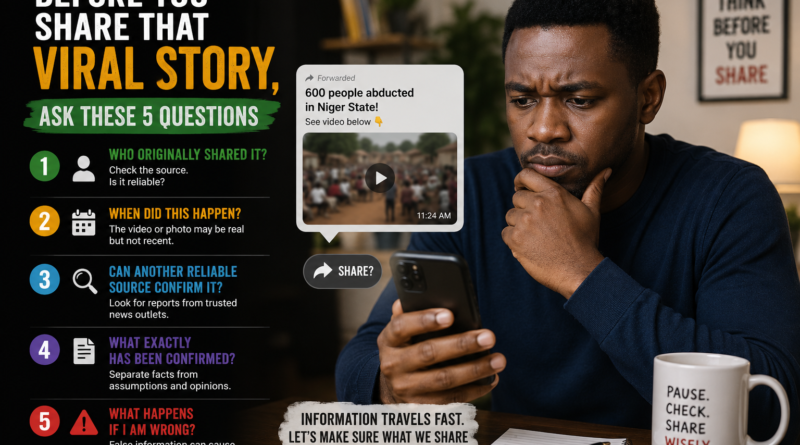
Before you share the next viral story, here are five questions worth asking.
1. Who originally shared it?
Before pressing the share button, look beyond the person who sent it to you.
Who first posted it?
Is it a recognised news organisation, an eyewitness, a government agency, or simply another social-media account repeating what someone else said?
A message that begins with “My friend who works with the government said…” is not the same thing as an official statement.
And a screenshot of a headline is not necessarily evidence that the headline is genuine.
The source matters.
2. When did this actually happen?
This is one of the easiest things to overlook.
A video can be real and still be misleading. It may show an actual event, but not the event being discussed today.
This happens frequently during emergencies. Old photographs and videos are taken out of their original context and presented as evidence of a new incident. Nigerian fact-checkers have documented several examples of old footage being recycled and falsely linked to recent kidnapping incidents.
So before sharing a dramatic video, ask:
When was this recorded?
If you cannot establish that, be careful about presenting it as current.
3. Can another reliable source confirm it?
One person’s post is a claim.
Several independent, credible sources reporting the same independently verified fact give us much more confidence.
This does not mean that everything reported by a large news organisation is automatically correct. Reputable journalists can make mistakes too. But responsible reporting normally involves checking information before publishing it.
So when something sounds shocking, search for confirmation.
Has Reuters reported it?
Has the BBC?
Has a credible Nigerian news organisation reported it?
Has the relevant government agency or institution issued a statement?
If nobody else can confirm it, perhaps we should pause before helping the story travel further.
4. What exactly has been confirmed?
This may be the most important question of all.
Sometimes a story contains a mixture of facts, assumptions and speculation.
For example, authorities may confirm that an attack happened. Residents may report that hundreds of people were taken. Social-media users may then conclude that they know exactly who carried out the attack, how many people were involved and what will happen next.
Those are not necessarily all established facts.
The recent Niger State kidnapping story demonstrates why this distinction matters. Reuters confirmed that an attack occurred and reported that President Bola Tinubu ordered an immediate rescue operation. However, Reuters also said it could not independently verify the reported figure of about 600 abductees.
Good information does not pretend to know more than it actually knows.
5. What happens if I am wrong?
This is the question I wish more of us would ask before sharing information.
If you share a funny rumour and it turns out to be false, the consequences may be small.
But what if the story involves kidnapping, communal tension, an alleged death, a missing person, a child, a public figure, or a security incident?
False information can create fear.
It can damage someone’s reputation.
It can cause families unnecessary distress.
It can create confusion when people are already frightened.
And once something goes viral, correcting it is much harder than spreading it.
That is why “I only forwarded it” is not always a good excuse.
Every time we share something, we help give it another opportunity to influence someone else.
We don’t have to stop sharing. We just have to become better at it.
Social media has changed how quickly information travels.
That is not necessarily a bad thing.
When something important happens, social media can help people find information quickly, connect with loved ones, raise awareness and draw attention to issues that might otherwise be ignored.
The problem is not social media. The problem is unverified information travelling at the speed of verified information.
We can do better.
We can pause, check the source, look at the date, and search for independent confirmation.
And when something has not been confirmed, we can simply say so.
There is nothing wrong with saying:
“I have seen this report, but I haven’t found independent confirmation yet.”
In fact, that may be one of the most responsible things we can say online.
Because being the first person to share something is not necessarily a sign that we are well informed.
Sometimes, wisdom is knowing when to wait.
Before you share, check.
Your next click may take only a second, but the information you put into someone else’s hands can travel much further than you ever intended.