How Social Media Could Shape Nigeria’s 2027 Election
Nigeria has not yet reached the 2027 general elections, but one thing is already clear.
The battle for people’s attention has begun.
Long before political parties officially ask Nigerians to vote for them, conversations are already happening online, politicians are building their public images, supporters are defending their preferred candidates, and influencers are joining political conversations. Old videos are resurfacing while new claims appear every day.
And somewhere in the middle of all this is the Nigerian voter, trying to figure out what is true.
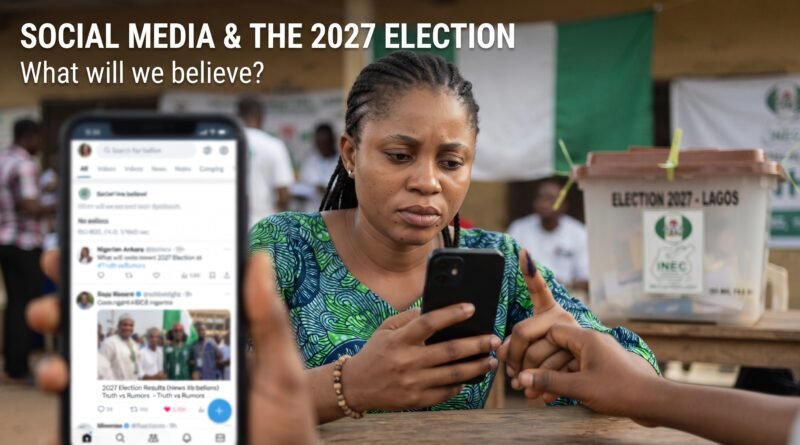
This is why the role of social media in the 2027 election deserves our attention now, not when voting day is around the corner.
Social media can inform us. It can also mislead us.
There is nothing inherently wrong with social media and politics.
In fact, social media can be a powerful democratic tool.
It allows politicians to communicate directly with citizens, gives ordinary Nigerians an opportunity to question leaders, and helps journalists distribute information quickly. It gives people access to political debates that might previously have been limited to television, newspapers or political rallies.
The problem begins when information becomes more important for how it makes us feel than whether it is true.
A frightening video gets shared because it makes people angry, a dramatic headline gets forwarded because it confirms what someone already believes, and a photograph is presented as evidence of an incident that happened yesterday, even though it was actually taken years ago.
And before anyone has checked the facts, thousands of people have already seen it.
That is where things become dangerous.
We are already seeing it
A FactCheckHub report published today warns that disinformation actors are increasingly exploiting Nigeria’s ethnic fault lines ahead of the 2027 elections. The report says false narratives can reinforce stereotypes and turn ordinary incidents into material for creating hostility between communities.
And we do not have to look far for an example.
Today, FactCheckHub also debunked a viral video that was being presented as showing youths in Bodinga, Sokoto State, assaulting an imam over alleged political campaigning.
The video was real. But the story attached to it was not.
FactCheckHub traced the footage to a Facebook post from November 2025 and found that it showed an incident in Kassala, Sudan, not Sokoto State.
Think about that for a moment.
The video itself was not fabricated.
Someone simply changed the context.
And that can be enough to turn an ordinary piece of footage into a powerful political weapon.
The most dangerous misinformation may contain a little truth
This is something we need to understand as we approach 2027.
False information does not always look ridiculous.
Sometimes it contains a real photograph, a real politician, a real speech, a real incident, or a real video.
What has been changed is the context.
Perhaps the photograph is from another year, or the video happened in another country.
Perhaps a politician said something, but the viral post removed the sentence before and after it.
Perhaps a genuine statistic has been presented without the information needed to understand it.
This is why simply asking, “Is this picture real?” is not enough.
We also need to ask: “Is this picture being used truthfully?”
Our emotions can make us easier to manipulate
This is where things become personal.
Most of us like to think that we cannot easily be manipulated. But human beings are emotional.
When we see something that makes us angry, afraid or excited, we are more likely to react quickly.
And political campaigns understand emotion.
A message that says, “Look at what they are doing to us!” can travel much faster than a carefully researched explanation of a policy.
Fear spreads.
Anger spreads.
Outrage spreads.
And social-media algorithms are designed to keep people engaged with content.
That means the most accurate information is not automatically the information that travels the furthest. Sometimes the most emotional story wins the attention battle.
Ethnicity and religion make this even more sensitive
Nigeria is a country of enormous diversity. That diversity is one of our strengths, but it can also be exploited.
When political messages begin to tell people that “these people” are the problem, or that “those people” cannot be trusted, we need to be particularly careful.
A misleading video about a mosque, a false claim about a Christian community, an old photograph presented as evidence of a recent attack, or a fabricated statement attributed to a political leader.
Any of these can deepen existing suspicions. And once people begin seeing politics through the lens of us versus them, facts can become secondary.
That is precisely why the misinformation conversation matters before the election, rather than after it.
We also need to examine our own behaviour
It is easy to blame politicians, influencers, or social-media platforms. But ordinary users also play a role.
Every time we forward an unverified message, we become part of its distribution network; every time we share a sensational headline without reading the article, we contribute to the problem; every time we see a claim about a politician we dislike and immediately believe it because it confirms our opinion, we make ourselves vulnerable; and every time we dismiss a factual report simply because we don’t like the person who said it, we are putting loyalty above truth.
We cannot demand better information while helping misinformation spread.
So what should we do before 2027?
We don’t need to become professional fact-checkers; but we can become more responsible information consumers.
Before sharing a political story, ask:
- Who published this?
- When was it published?
- Where did the photograph or video originally come from?
- Has another credible source reported the same thing?
- Is the headline actually supported by the article?
- Am I sharing this because it is true, or because it confirms what I already believe?
That last question may be the hardest one. Because sometimes the person most likely to fool us is not a politician or an anonymous account. Sometimes it is our own bias.
The 2027 election will not only be fought at rallies
It will be fought on our phones. It will be fought through videos, memes, podcasts, Facebook posts, WhatsApp messages, TikTok clips, X posts and online conversations.
Some of those conversations will be genuine, some will be misleading, some will be deliberately designed to influence us, and some will simply be ordinary Nigerians expressing their opinions.
Our responsibility is to learn the difference. Because democracy does not only depend on people having the right to vote. It also depends on people having access to reliable information with which to make that choice.
The question we should therefore be asking before 2027 is not simply: “Who are you voting for?”
Perhaps we should first ask: “Where are you getting your information from?”
Because if someone else can control what you believe before you enter the voting booth, they may already have influenced your vote.
Your vote is yours.
So should be your judgment.