
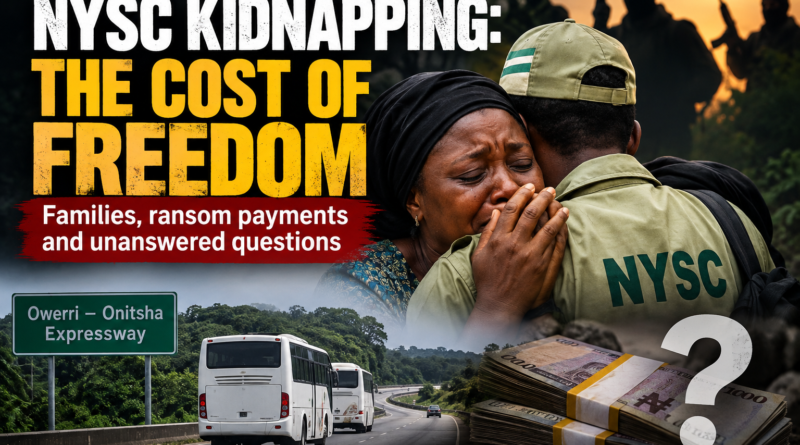
NYSC Kidnapping: “We Paid Millions for Our Children’s Freedom” – Families
When the 20 prospective National Youth Service Corps members who were abducted in Imo State were finally released, there was a reason for Nigerians to be relieved. The young graduates had spent days in captivity after gunmen attacked the buses conveying them to their orientation camps. Their families endured the fear and uncertainty of not knowing whether their loved ones would return home safely.
However, their release brought another troubling issue. Some of the families say they paid millions of naira in ransom to secure their children’s freedom, while the police maintain that the victims were rescued through sustained security operations.
The disagreement raises important questions about what happened behind the scenes, the burden kidnapping places on families, and how Nigeria responds to the growing threat of abduction.
A Journey to National Service That Turned Into a Nightmare
The prospective corps members were travelling from Ibadan to orientation camps in Abia and Akwa Ibom states when gunmen attacked two buses along the Owerri–Onitsha Expressway on October 1, 2026. The attackers abducted passengers, including the young graduates, and took them into the bush.
What should have been the beginning of a new chapter in their lives became a frightening ordeal for them and their families. Parents and relatives were suddenly faced with the possibility of losing their children to people whose demands were both frightening and difficult to meet.
According to reports by TheCable and Premium Times, the kidnappers initially demanded ₦50 million for each captive. One mother, Alirat Wahab, said her family eventually paid ₦6 million after negotiations and appeals to the abductors. Other families also reportedly contributed money or borrowed funds to meet ransom demands. TheCable’s report and Premium Times’ report provide details of the competing accounts.
The police announced on October 7 that the 20 prospective corps members had been rescued through a joint operation involving the police, military and Department of State Services. The victims were taken for medical assessment before reuniting with their families.
Who Secured Their Freedom?
This is where the accounts begin to differ. Some parents have publicly stated that they raised and paid ransom to secure the release of their children. One family described how relatives travelled to meet intermediaries and were instructed to convert the money into US dollars. Other relatives said friends and well-wishers contributed towards the payments.
The Imo State Commissioner of Police, Audu Bosso, said he was not aware of any ransom payment. He attributed the release to pressure from security operatives, who had been searching for the victims and pursuing their abductors. He also said operations to apprehend those responsible were continuing.
These accounts should not be confused with an established finding about exactly how the release was secured. The families’ statements are firsthand accounts of their own experiences, while the police have described the security operation. A full, transparent account would help establish how these events unfolded and whether the different efforts contributed to the outcome.
Whatever the circumstances, the safe return of the young people is welcome news. It is also reasonable for the public to expect clarity about an incident that raised serious concerns about security on a major road.
The Financial Cost of Saving a Loved One
One of the most painful aspects of this story is the financial burden reportedly placed on the families.
For a household with substantial resources, raising millions of naira may be difficult. For a family that depends on farming, salaried employment or a small business, the same amount could mean borrowing from several people, selling assets or sacrificing plans that took years to develop.
Some relatives reportedly appealed to friends and well-wishers for assistance. Others described having to borrow money to meet the demands.
It is difficult to imagine the pressure facing a parent who is told that a child may be released if a particular amount is paid. Under such circumstances, the decision is not simply a financial calculation. It is made under fear, uncertainty and the desperate desire to bring a loved one home alive.
Families who say they paid ransom should not be treated as though they caused the problem. They were responding to a frightening situation in which they believed their children’s lives were at stake.
At the same time, the wider implications of ransom payments cannot be ignored. If kidnapping becomes a means of generating income for criminal groups, the financial burden extends beyond individual families to the wider society.
Rescue Is Important, but Prevention Matters Too
The return of the abducted graduates is a positive outcome, but it does not erase the circumstances that made the incident possible. The attackers were able to intercept vehicles carrying passengers along a major highway, abduct young people travelling to begin national service and hold them for days.
The police have said efforts to arrest the perpetrators are continuing. That remains important because the release of the victims is not the same as bringing those responsible to justice.
There is also a need to examine how travellers can be protected on vulnerable routes, how intelligence can be used to prevent attacks, and how security agencies can respond quickly when kidnappings occur. These are not questions that should disappear simply because the immediate crisis has ended.
The disagreement over ransom payments also makes transparent communication important. When families provide accounts that differ from official statements, authorities should explain what they know, what remains under investigation and what can be disclosed without compromising security operations.
Public trust depends not only on announcing successful outcomes but also on providing credible explanations of how those outcomes were achieved.
What Should Nigerians Take Away From This Story?
The most important fact is that 20 young people who were abducted while travelling to begin national service have returned to their families. Their safe return deserves recognition, and their recovery should remain a priority.
However, the reported ransom payments and the differing accounts of the release deserve attention as well. Nigerians should be able to celebrate the return of the victims while still asking reasonable questions about the circumstances of their abduction, the response of security agencies and the steps being taken to prevent another incident.
No parent should have to raise millions of naira under the threat of losing a child. No young graduate should have to fear being abducted while travelling to fulfil a national obligation.
The real measure of progress will not be how quickly we move on from this story, but whether lessons are learnt and practical action follows.
Bringing the victims home was essential. Making Nigeria’s roads safer, pursuing the perpetrators and ensuring that families are not left to face such ordeals alone are equally important.