

Your Bank Isn’t Shutting Down: What the OPay Rumour Taught Us About Money and Panic
A relative of mine forwarded me a notice last week, breathless, telling me to move my money before it was too late. That is how fast a single message can travel once it touches something as personal as money.
Someone creates a notice. It looks official enough. It carries the name of a familiar company, gives a specific date, and tells people to act immediately. Within a short time, it is everywhere. People forward it to family and friends, WhatsApp groups become active, and social media users start asking whether it’s true.
Then comes the most dangerous part: some people act before they verify.
This was the reality behind the recent viral claim that OPay would suspend its operations and go on an indefinite break from September 1, 2026. The message advised customers to withdraw their money to avoid inconvenience, and it raised real concern among users.
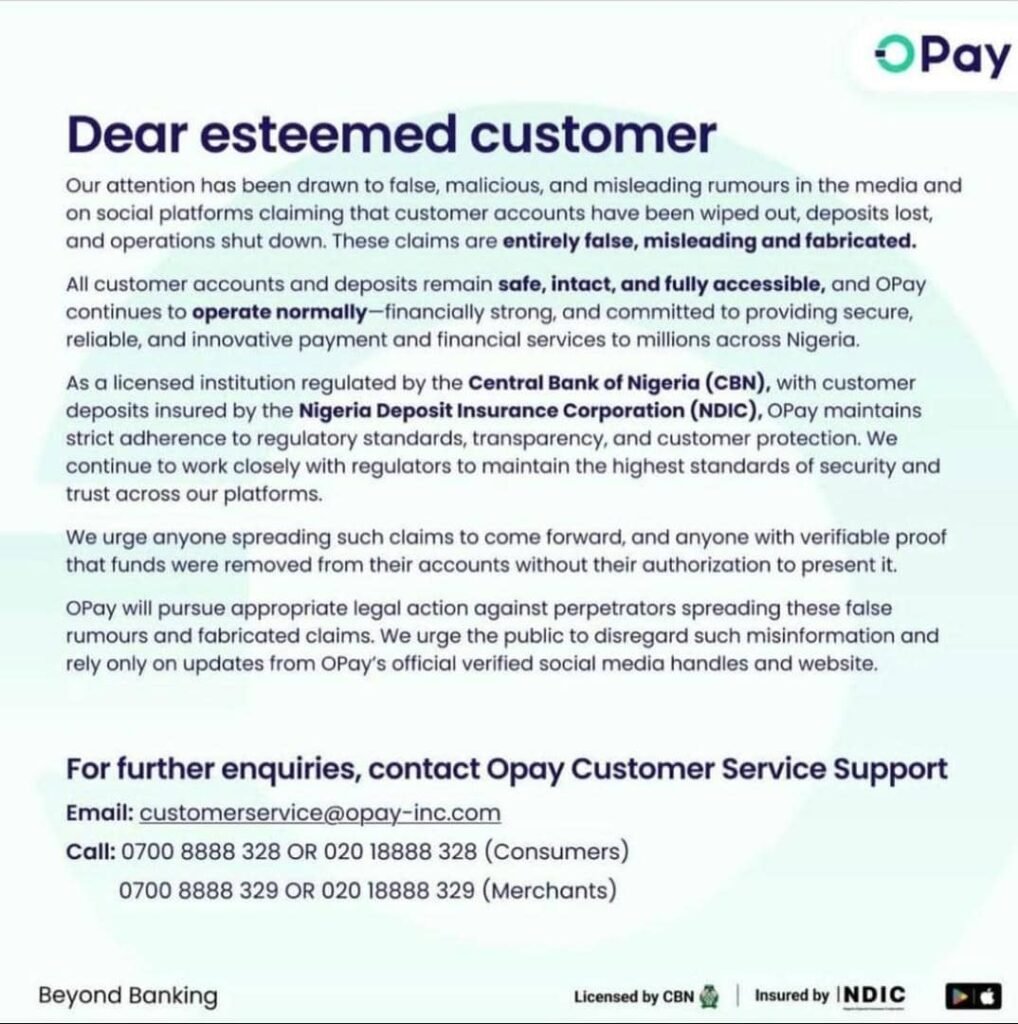
OPay publicly dismissed the notice as false, said it was not shutting down or going on a break, and urged customers to rely on its official communication channels, pointing out that the viral publication contained inconsistencies. Reports also indicated that the person connected with one of the viral posts later deleted it and acknowledged that the information was false.
But perhaps the most interesting part of this story is not simply that a false rumour circulated. It is what the rumour revealed about how Nigerians react when their money appears to be at risk.
When It Is Your Money, Panic Travels Faster
There are many things people may ignore online. A celebrity rumour may entertain them, a political argument may annoy them, and a fake giveaway may catch their attention. But tell someone that a financial institution is about to shut down and that they need to move their money immediately, and the situation becomes very different.
Suddenly the message feels urgent. People do not want to take chances. They begin thinking, what if this is true? And that question alone can be enough to make someone act.
This is one of the reasons financial misinformation is particularly dangerous. The person receiving the message may not know whether it is genuine, but they may decide that withdrawing their money is safer than waiting for confirmation. After all, they reason, if it turns out to be false, I can always return the money. But what if it’s true and I lose access to my funds? That fear can make even intelligent, careful people act quickly.
The Problem With Messages That Look Official
One of the biggest challenges of the digital age is that creating something that looks official is not very difficult. A person can copy a company logo, imitate the style of a corporate announcement, use formal language, add a specific date, and even call the document an “official notice.” For someone scrolling quickly through social media or reading a forwarded WhatsApp message, that can be enough to create an impression of authenticity.
This is why we can no longer judge information simply by how professional it looks. A message can have a logo and still be fake, a document can use formal English and still contain false information, and a post can receive thousands of shares and still be completely fabricated. The appearance of credibility is not the same thing as actual credibility.
Why Do We Forward Before We Verify?
Sometimes people share information because they genuinely want to help others. Someone receives a warning and thinks about the friends and family who use the service, so they forward it with good intentions: just in case, please be careful, I don’t know if this is true, but let me share it.
The problem is that the words “I don’t know if this is true” do not reduce the harm caused by forwarding false information. Forwarding an unverified message simply because it might be true is exactly how misinformation becomes widespread. Every person who forwards it gives it another layer of credibility. A message from a stranger may be ignored, but the same message forwarded by your sister, friend, colleague or trusted WhatsApp group feels more believable. The original source may be unknown, but trust travels through the people sharing it.
Financial Fear Is Different
Money is personal. For many Nigerians, money sitting in a bank or fintech account represents rent, school fees, business capital, food, transport or emergency savings, so the thought of suddenly losing access to it creates immediate fear.
And in a country where people have lived through bank failures, failed investment schemes, Ponzi schemes, financial scams and sudden economic changes, financial anxiety does not exist in a vacuum. People remember previous experiences; they remember stories of others losing money, and they remember being warned too late. This history makes Nigerians particularly sensitive to anything suggesting a financial institution may be in trouble. That does not mean every rumour should be believed, but it means companies, regulators and the public all have a role to play in communicating quickly and clearly when misinformation begins to spread.
Panic Can Create Its Own Problems
Sometimes a false rumour creates the very problem people are afraid of. Imagine thousands or millions of customers suddenly trying to move their money because they believe a financial institution is shutting down. The rush itself creates confusion, customer service channels get overwhelmed, apps experience unusually high traffic, and social media fills with screenshots, complaints and speculation.
Then people point to those temporary problems as proof the original rumour was correct. Someone says, “I knew something was wrong, the app was slow.” But the app may be slow precisely because thousands of people are trying to withdraw their money at the same time, because of the rumour. This is how fear can sometimes create its own evidence.
Verify Before You Act
Perhaps the simplest lesson from this incident is this: do not make financial decisions based solely on a forwarded message. If a message claims that your bank, fintech platform or financial institution is shutting down, pause before you act. Check the company’s official website, look at its verified social media pages, check whether reputable news organisations are reporting the development, and contact the company’s official customer support channels if necessary.
Most importantly, ask where the information originally came from. If nobody can answer that, you already have a reason to be cautious. Technology has made financial services faster and easier, sending money, paying bills, running a business from a phone, but that convenience comes with a new responsibility: learning to recognise that a logo does not make a document genuine, that screenshots can be manipulated, and that the habit of pausing before forwarding is now a basic digital skill.
The question worth asking is not who forwarded it to you, or how many people have shared it, or how official it looks. It is who originally made the claim, and where it can be verified.
A Rumour Can Be Free, but Its Consequences Are Not
Creating a false message may take only a few minutes. Sharing it may take only a few seconds. But the consequences can be much bigger: people panic, businesses suffer reputational damage, customers make unnecessary financial decisions, trust weakens, and companies spend time and resources responding to problems that never existed in the first place.
The recent OPay rumour is more than a story about one fintech company. It is a reminder that we now live in a world where information can move faster than verification, where fear can make a false message feel believable, and where every one of us has a role to play in deciding whether misinformation keeps travelling.
The next time you receive a message telling you to urgently move your money because a financial institution is supposedly in trouble, take a moment before you panic. Verify. Check the source. Look for official confirmation.
When it comes to your money, fear may be urgent, but the truth still deserves a few minutes of your time.