
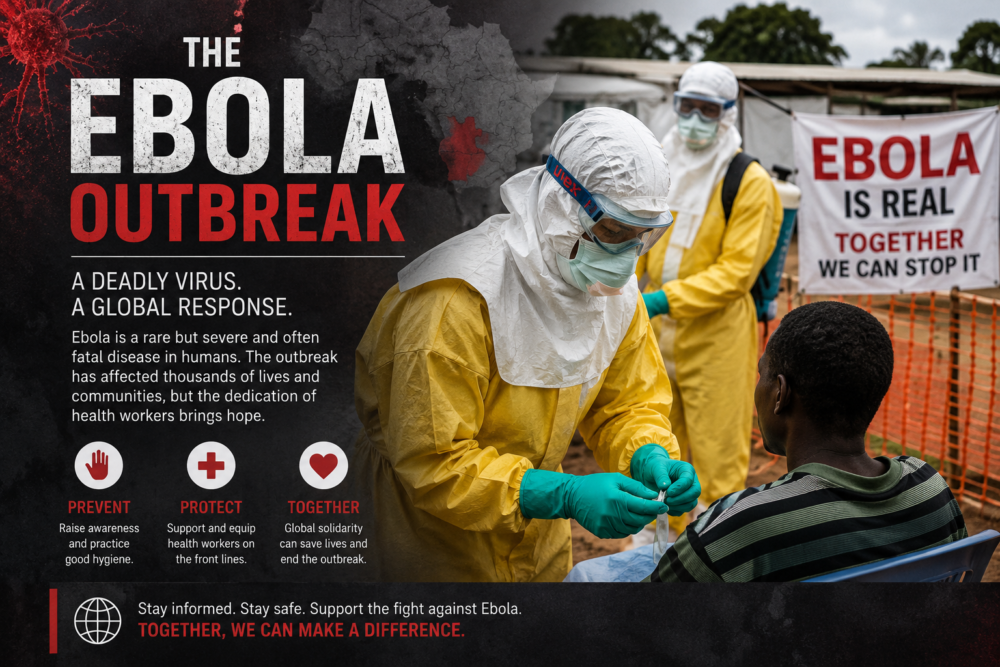
Ebola Is Back: What the 2026 Outbreak Means for Africa, and for Us
A deadly outbreak declared a global health emergency. A virus with no approved vaccine. Hundreds of suspected cases, and the news is moving fast. Here is what you need to know, and why it matters.
In early May 2026, a hospital in Bunia, a city in the Ituri Province of northeastern Democratic Republic of Congo, began noticing something deeply alarming: a cluster of severely ill patients, including healthcare workers, dying of an unknown illness. Initial tests for Ebola came back negative, and for almost two weeks, no one had a definitive answer.
The reason those early tests failed is chilling in hindsight: they were designed to detect the Zaire strain of Ebola, the most well-known type. What was spreading through Ituri was something rarer, something that slipped past the first line of detection. On 14 May 2026, laboratory results finally confirmed it: Bundibugyo virus, a species of Ebola that has only ever been recorded twice before in history.
By the time the DRC officially declared an outbreak on 15 May, hundreds of suspected cases had already been reported. The virus had already crossed into Uganda. And within two days, the World Health Organisation had declared it a Public Health Emergency of International Concern; the highest alarm the global health community can raise short of a pandemic.
This is a developing situation. And as Africans, and as Nigerians in a continent that has faced Ebola before, it is one we cannot afford to watch from a comfortable distance.
What Is the Bundibugyo Virus?
Most people have heard of Ebola, but Ebola is not a single virus; it is a family. Four types cause disease in humans: Zaire (the most common and most deadly), Sudan, Tai Forest, and Bundibugyo. The 2026 outbreak is caused by the Bundibugyo virus, also called Bundibugyo Virus Disease (BVD).
Bundibugyo was first identified in 2007 in Uganda and appeared again in DRC in 2012. Before this outbreak, only two recorded instances existed in history. This is the third, and by far the largest.
What sets Bundibugyo apart from other Ebola strains:
- It is rarer, which means less is known about it, and standard Ebola tests do not detect it.
- There is no approved vaccine against the Bundibugyo virus. The Ebola vaccines that exist (such as rVSV-ZEBOV) are designed for the Zaire strain and do not work here.
- There are no approved specific therapeutics, either — treatment is supportive care only.
- The case fatality rate ranges from 25% to 50%, lower than the Zaire strain (which can reach 90%), but still extremely serious.
- It spreads through direct contact with the bodily fluids of infected people, not through the air or casual contact
The absence of a vaccine for this strain is perhaps the most serious complication of this outbreak. It means the tools that helped contain previous Ebola outbreaks are simply not available here.
Where We Are Right Now
As of 19 May 2026, the situation is as follows:
- Nearly 500 suspected cases and over 116 deaths have been reported, according to the United Nations
- Cases have spread across at least 9 health zones in Ituri Province, DRC — including the cities of Bunia, Rwampara, and Mongbwalu
- Two laboratory-confirmed cases were reported in Kampala, Uganda, both linked to travel from DRC
- A confirmed case was also reported in Goma — a major city in North Kivu Province — after an infected woman travelled there from Ituri
- An American physician working as a missionary in DRC tested positive for the virus on 18 May and has been transported to Germany for treatment
- The WHO has declared this a Public Health Emergency of International Concern (PHEIC) — its second-highest designation
- WHO has advised against closing international borders
- There is no confirmed case in Nigeria at the time of writing.
Health experts have also raised serious concerns about how advanced the outbreak was by the time it was officially identified. Epidemiologist Jennifer Nuzzo, quoted in media reports, has suggested that cuts to global health programmes may have contributed to delays in early detection. By the time confirmation came, hundreds of suspected cases had already accumulated.
Why This Matters for Nigeria and West Africa
Nigeria knows Ebola. In 2014, during the devastating West Africa outbreak — the largest Ebola outbreak ever recorded, the Zaire strain arrived on Nigerian soil via Lagos. The country responded with remarkable speed and containment, earning global recognition for how it managed to stop wider spread. But that experience also showed us how quickly Ebola can travel, how easily it can be carried on a flight, and how a single case in a dense, well-connected city can become something far more serious.
The current outbreak is centred in Ituri Province, a region characterised by significant population displacement, active mining activity, and frequent cross-border movement. These are exactly the conditions that make containment difficult and spread more likely. Goma, where a case has already been confirmed, is a major transit hub. Kampala, Uganda’s capital, already has confirmed cases.
Nigeria sits thousands of kilometres away from Ituri, but distance offers limited protection in a continent with active air and land travel. The NCDC (Nigeria Centre for Disease Control) has not yet issued a formal advisory at the time of writing, but it would be wise for Nigerians, particularly those working in health, travelling to DRC or Uganda, or hosting people from affected regions, to stay informed and exercise heightened vigilance.
This is not a call to panic. It is a call to pay attention. Information is one of the most powerful tools in a public health crisis.
The Bigger Implications: What This Outbreak Reveals
Beyond the immediate health emergency, the 2026 Bundibugyo outbreak raises questions that Africa and the world cannot keep avoiding.
1. The cost of underfunded global health systems
Experts have pointed to reduced investment in global health surveillance as a factor in the delayed detection. When health systems are underfunded and programmes are cut, the early warning systems that catch outbreaks before they explode simply do not work as well. The world discovered this with COVID-19. We are being reminded of it again now.
2. The gap in vaccine and treatment coverage for rarer strains
The existing Ebola vaccines do not cover Bundibugyo. This is a critical gap. For years, global health investment has focused on the most common strain, understandably, but the Bundibugyo outbreak is a stark reminder that preparedness must account for rarer threats too. The WHO has emphasised the urgent need to accelerate research and clinical trials for this strain.
3. The vulnerability of conflict-affected and high-movement zones
Ituri Province is not just geographically remote; it is a region marked by instability, armed conflict, and population displacement. The eastern DRC has been battling both health and security crises simultaneously for years. Containing Ebola in such conditions is exponentially harder. This is a humanitarian challenge as much as a medical one.
4. Africa must lead African health security
The Africa CDC is actively involved in coordinating the response, and institutions such as the INRB (Institut national de recherche biomédicale) in the DRC were central to confirming the diagnosis. This matters. The continent cannot wait for external agencies to save it. Strengthening African-led health institutions with adequate funding, infrastructure, and political will is not an abstract goal. It is a survival strategy.
How Ebola Spreads, and How It Does Not
One of the most important things we can do in a health crisis is get our facts right. Misinformation spreads faster than viruses, and it costs lives. Here is what we know about how Ebola, including the Bundibugyo virus, spreads:
It spreads through:
- Direct contact with the blood, secretions, organs, or other bodily fluids of infected people
- Contact with surfaces and materials contaminated with these fluids
- Contact with infected animals (bats and primates are known reservoirs)
- Funeral or burial practices that involve touching the body of someone who died from the virus; this is a significant transmission route.
- Healthcare workers who are exposed without adequate protective equipment.
It does NOT spread through:
- Air: you cannot catch it by breathing near an infected person.
- Casual contact: shaking hands, sitting near someone, or being in the same room.
- Food or water (unlike cholera).
- Mosquitoes or other insects.
This is why Ebola, while terrifying, has historically been containable when the response is swift and the public is informed. The challenge is always in the delay, the weeks when people do not know what they are dealing with, when healthcare workers are infected, when burial practices continue unchanged. That is where lives are lost.
What You Can Do Right Now
You are in Nigeria. The outbreak is currently confined to DRC and Uganda. But awareness and preparation are never wasted. Here is what is practical and sensible:
- Follow credible sources: The Nigeria Centre for Disease Control (NCDC), the World Health Organisation (WHO), and Africa CDC are your best sources of current, verified information. Avoid sharing unverified reports on social media.
- If you are travelling to DRC or Uganda, follow the CDC Level 3 Travel Health Notice for DRC. Avoid non-essential travel to affected regions and follow all health screening protocols.
- If you work in healthcare: Stay updated on infection prevention and control (IPC) guidelines from the NCDC and WHO. Know the symptoms to watch for in patients.
- Avoid handling the bodies of people who may have died from unknown febrile illness, and report unexplained deaths or illness clusters to health authorities immediately.
- Do not spread fear, spread facts. Misinformation about Ebola causes as much damage as the virus itself. Share verified information, not rumour.
Closing Thoughts: We Cannot Afford Complacency
There is a particular kind of fatigue that sets in after COVID-19, a weariness with health emergencies, a desire to look away from the next alarming headline. I understand that. We all do. But looking away is a luxury that those of us on this continent cannot fully afford.
The 2026 Ebola outbreak is a reminder that infectious diseases do not respect borders or indifference. It thrives in information gaps, underfunded systems, and in communities that do not know what they are facing until it is too late. Awareness is not panic; it is preparation, and preparation saves lives.
Pray for the communities in Ituri. Advocate for stronger African health institutions. Stay informed. And if you are in a position to support organisations doing work on the ground, consider it.
We are one continent. What happens in Bunia does not stay in Bunia.
This post reflects information available as of 20 May 2026. The outbreak situation is actively evolving. Please check the NCDC (ncdc.gov.ng), WHO (who.int), and Africa CDC (africacdc.org) for the most current updates.